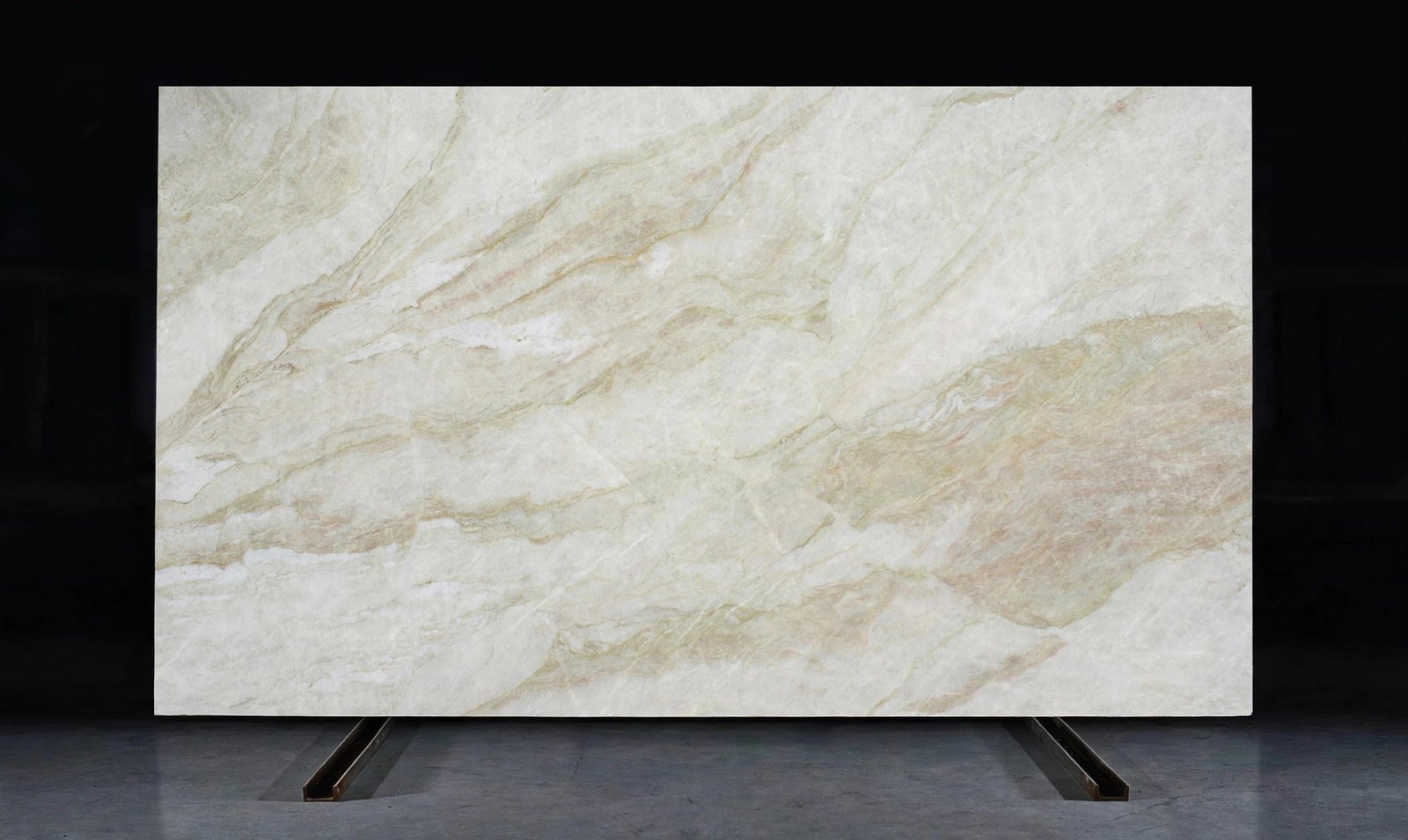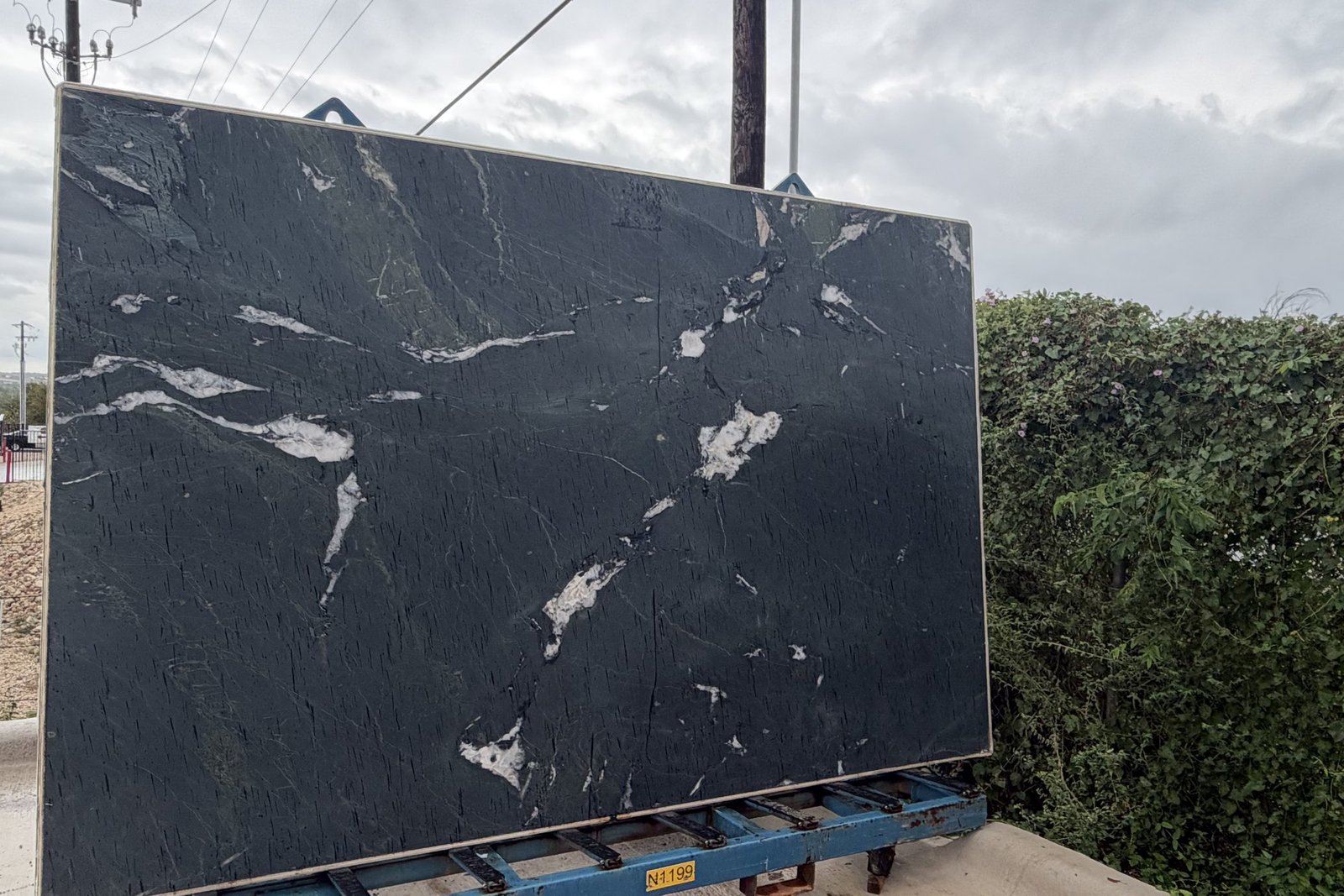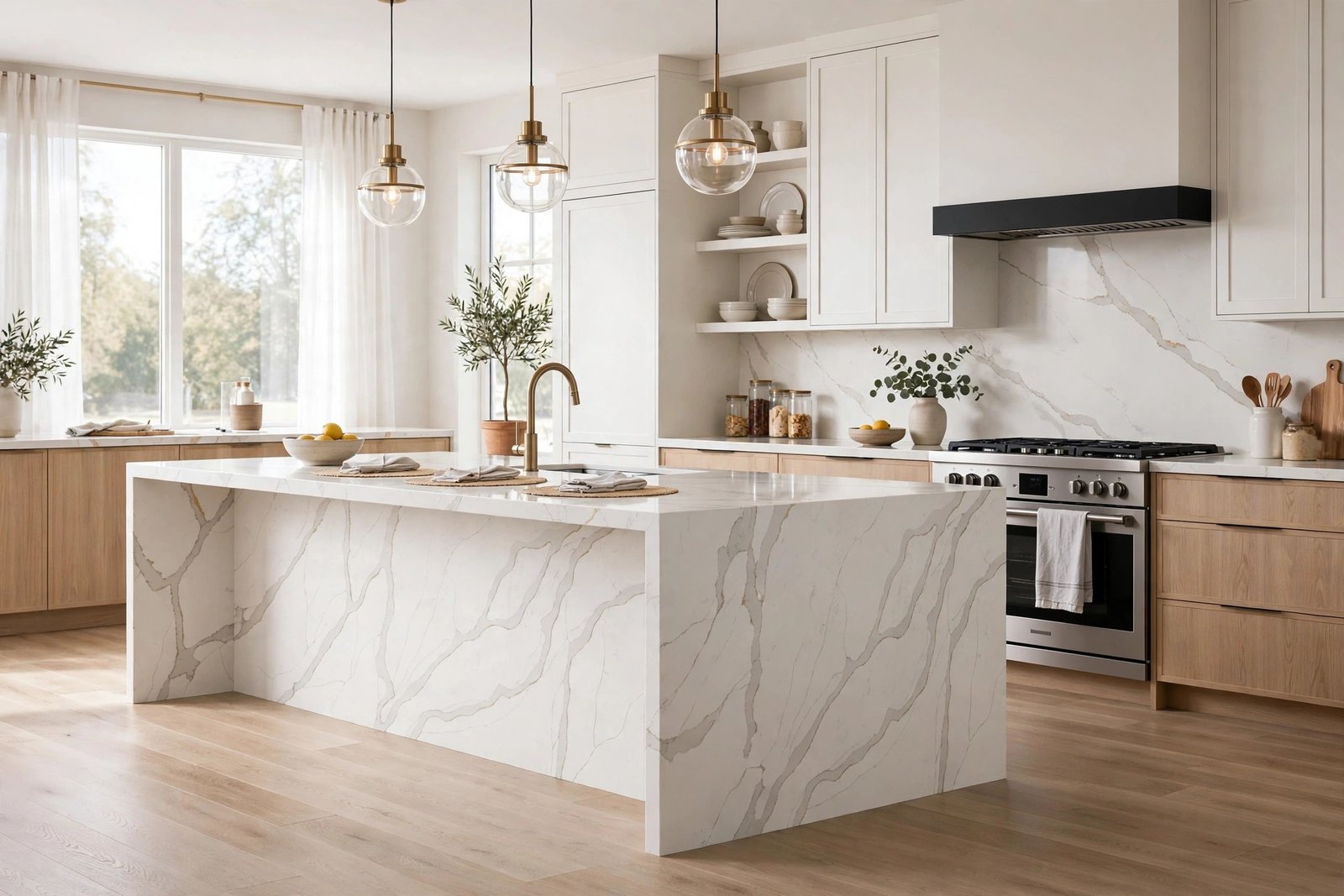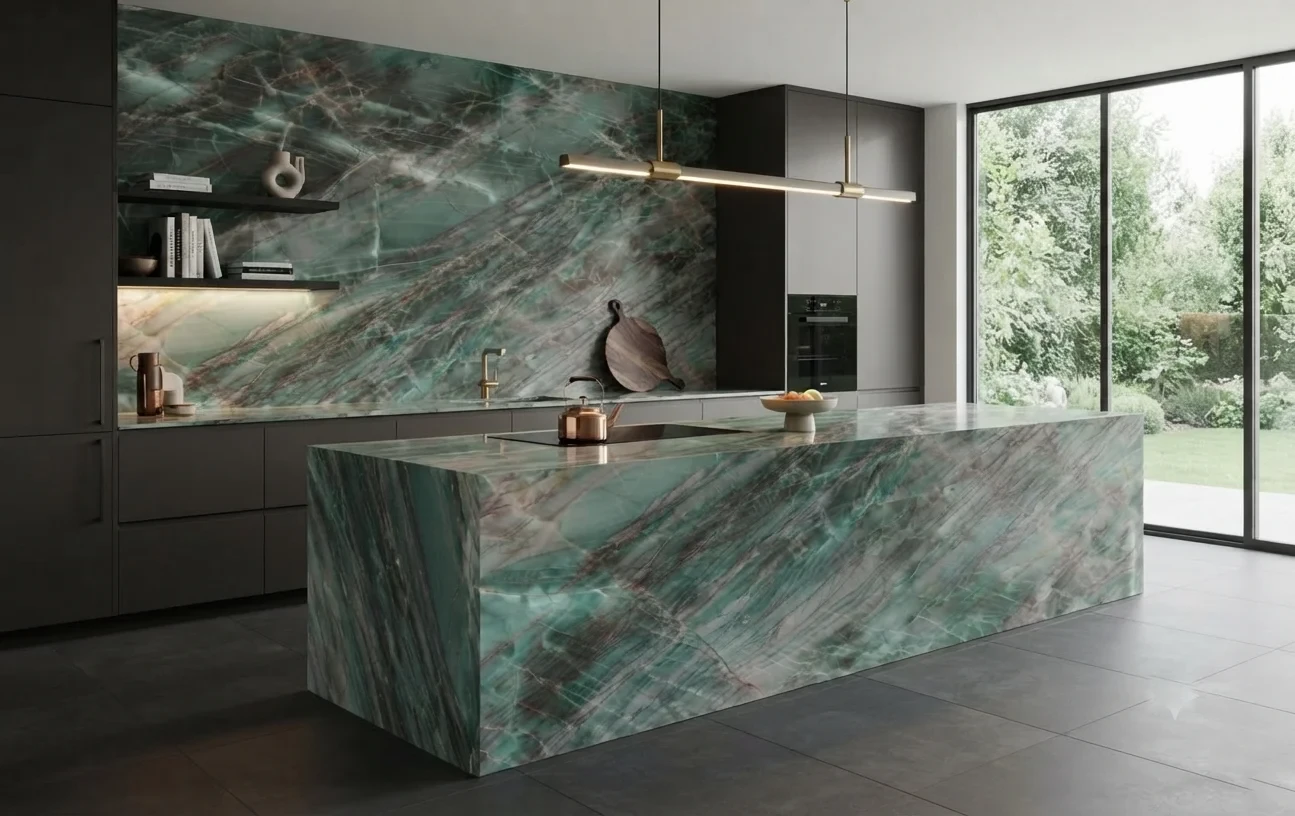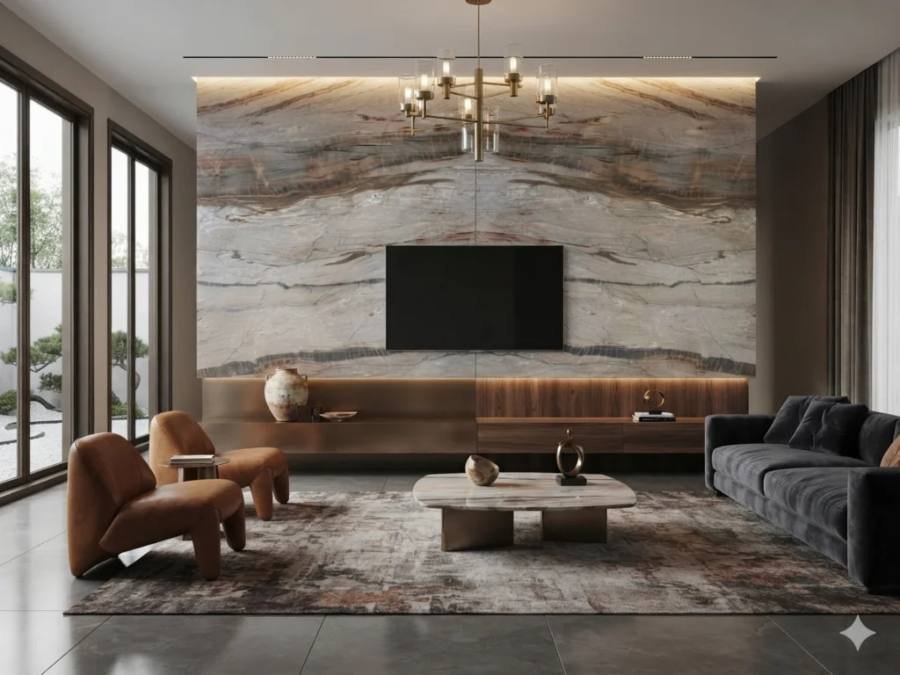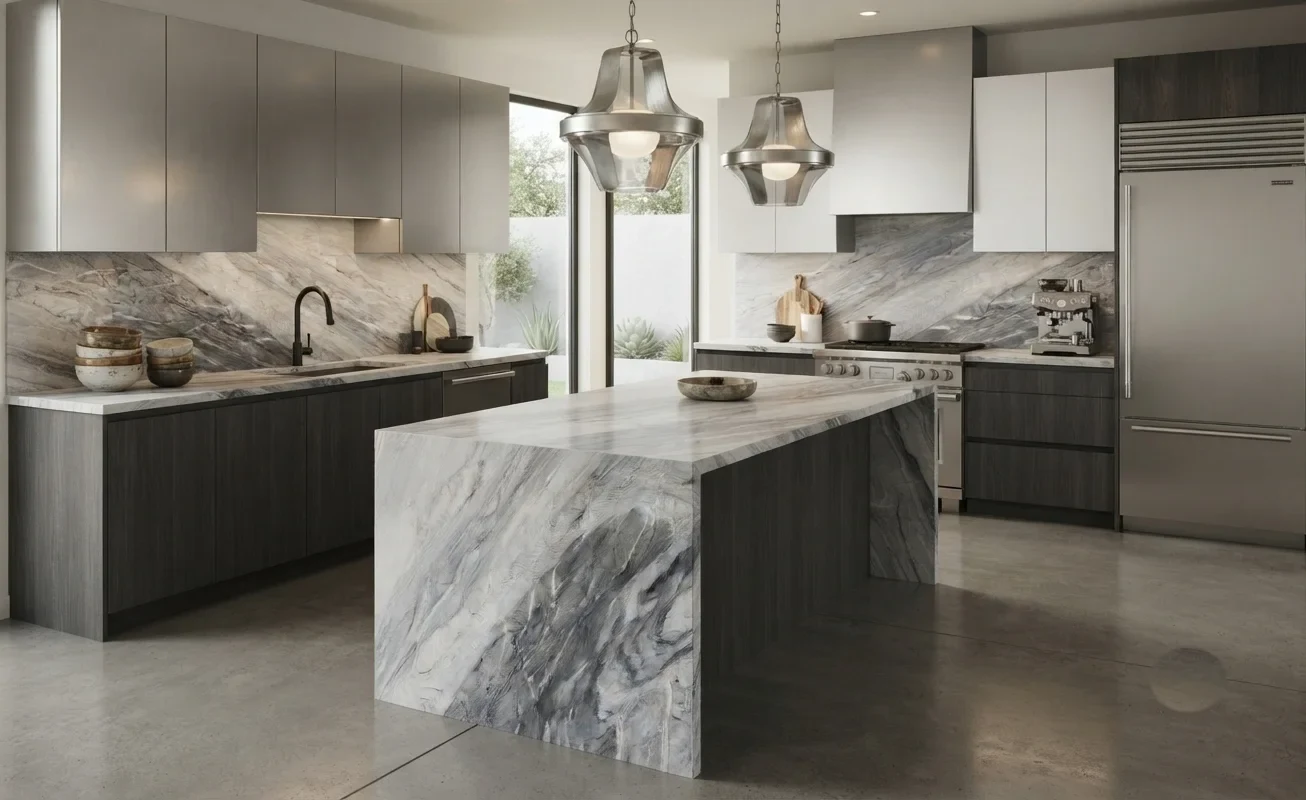
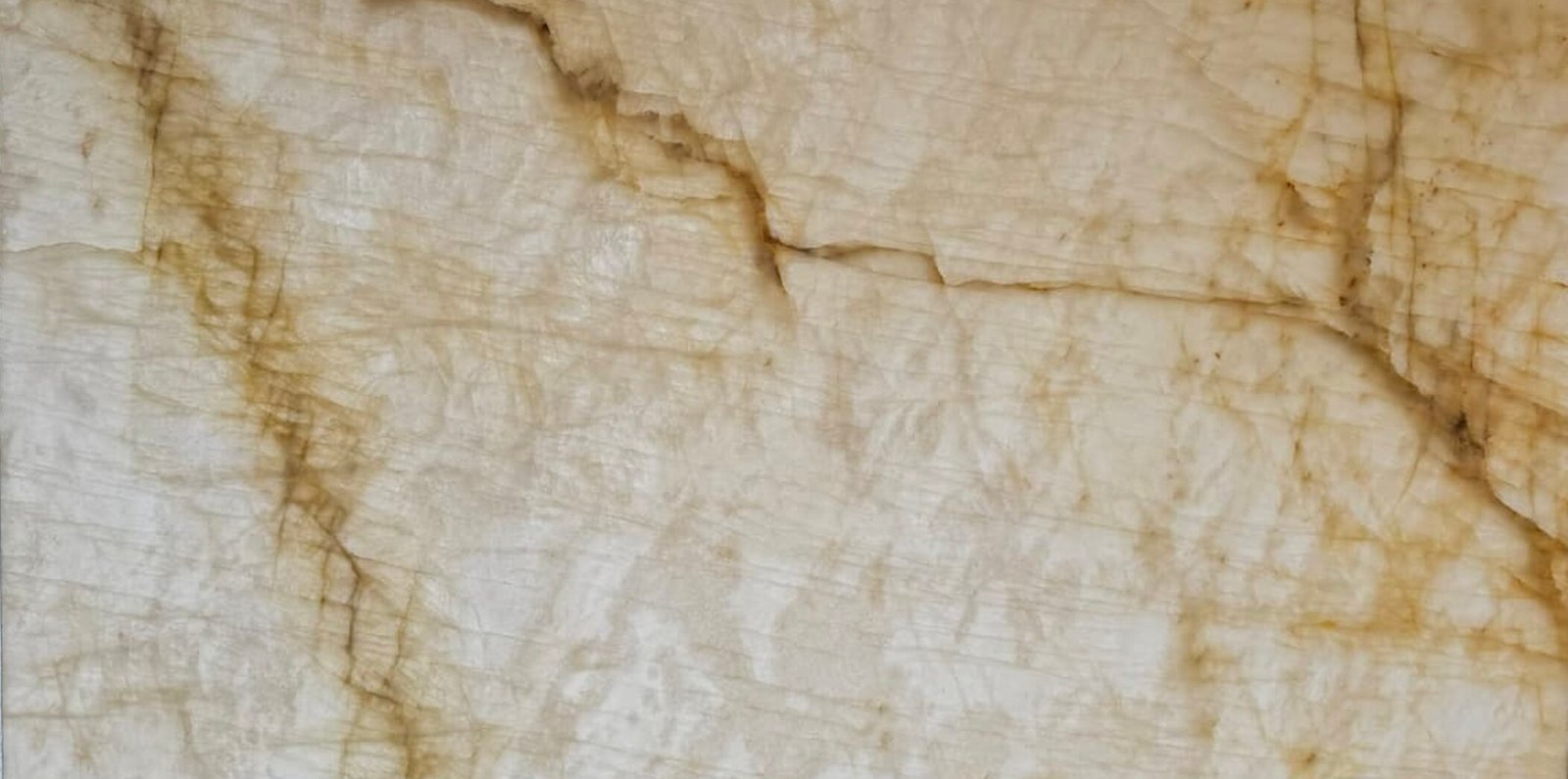
Why choose quartzite? Quartzite begins as sandstone and is transformed by heat and pressure into one of the hardest surfaces you can put in a kitchen — harder than granite, and far less porous than the marble it is so often mistaken for. Most of the slabs in our Buda yard are quartzite, stocked at 3 cm.
No two slabs are ever identical — each is shaped over thousands of years by heat, pressure and mineral deposits. That depth and character is what manufactured surfaces can’t match, and it’s why we sell slab by slab, so you choose the exact piece you’re taking home.
Why choose quartzite? What to know before you specify it
Quartzite slabs are sold one at a time because they vary. Two slabs cut from the same block will share a family resemblance; two blocks out of the same quarry may not. If a job needs bookmatched pieces, or a continuous run across an island and its backsplash, say so early so the right slabs are held together rather than sold apart.
Not everything sold as quartzite behaves like it, either — some of what reaches the market is softer and closer to marble in practice. Ask what a slab actually is and ask where it was quarried. Everything in this yard is stocked at 3 cm, and we can tell you the country it came from.
KJM Stones imports quartzite direct from quarries in Brazil and India and stocks it at our yard in Buda, Texas. We supply fabricators, builders and designers along the I-35 corridor from Georgetown to San Antonio, which means you are buying quartzite slabs in Texas from the importer rather than through a local distributor.
Every stone behaves a little differently once it is living in a kitchen. The Natural Stone Institute keeps free care and cleaning guidance for natural stone, an independent starting point on everyday products, spills and stains.
Stone Types at a Glance
Quartzite is not the only stone worth knowing. Here is how the main natural stone types compare:
| Stone Type | What It Is |
|---|---|
| Quartzite | A metamorphic stone formed from sandstone under intense heat and pressure. Extremely hard and scratch-resistant, it offers marble-like veining with far greater durability, making it ideal for kitchen countertops. |
| Granite | An igneous rock formed from cooled magma, prized for its rich speckled patterns and vast range of colors. It is heat- and scratch-resistant, and a long-time favorite for countertops and heavy-use surfaces. |
| Soapstone | A soft metamorphic stone rich in talc, known for its smooth, warm feel and subtle gray tones that deepen over time. Naturally non-porous and heat-resistant, it brings a timeless, understated look. |
| Dolomite | A sedimentary stone that sits between marble and quartzite in hardness. It delivers the soft, elegant look of marble with better resistance to scratching and etching, offered in soft whites and grays. |
See the Slabs in Person
Photos only go so far with natural stone — the depth, movement and crystal in a quartzite slab are best judged standing in front of it. Browse the full natural stone collection, then visit the KJM Stones yard at 5229 FM 2001, Buda, Texas 78610, or call (726) 241-4903. Open Thursday and Friday, 9:00 AM to 4:30 PM, and Saturday, 9:00 AM to 3:00 PM. Monday, Tuesday and Wednesday are by appointment only.
If you are still deciding why to choose quartzite over granite or marble, the short answer is the combination: the look of marble, the hardness of granite, and a slab that is yours alone. Bring a cabinet door, a paint sample and your fabricator’s questions. We will pull the bundles that match, hold them at the yard, and let you decide at your own pace.